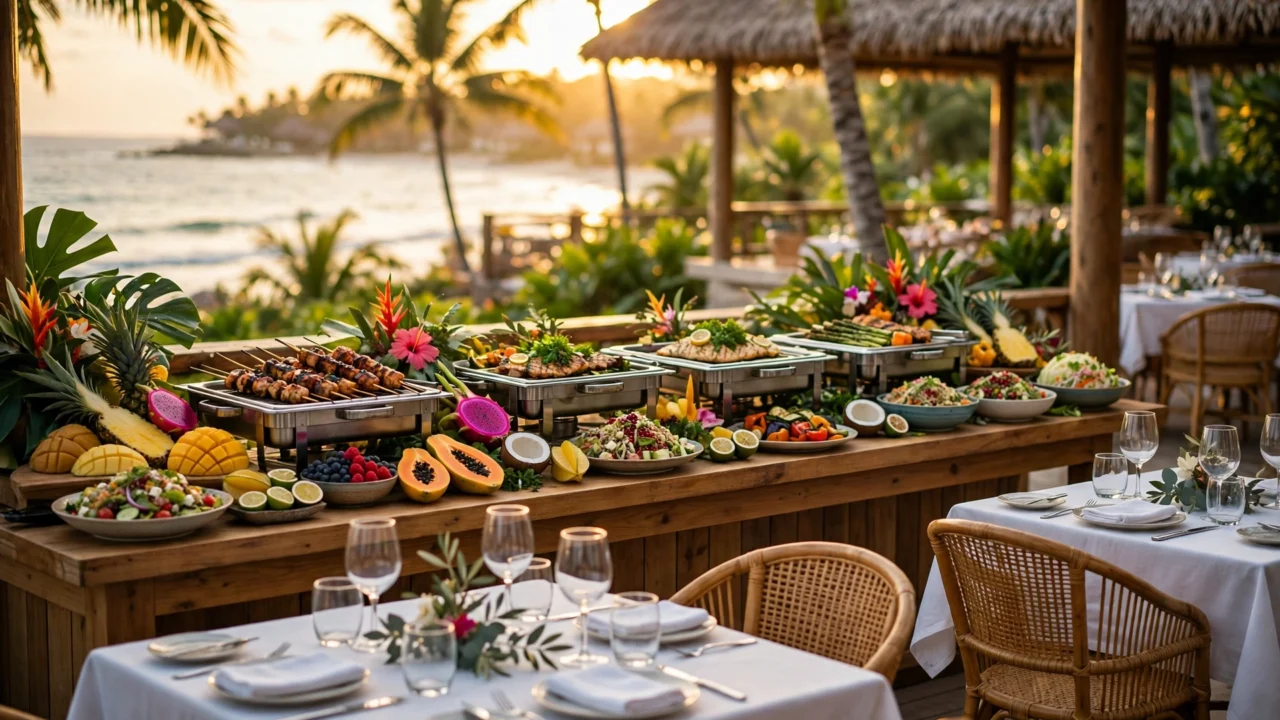
Food is the part of an all-inclusive holiday you cannot escape. You can skip the pool, ignore the evening show and never set foot in the spa, but you will eat at the resort three times a day, every day. That is why the best food all inclusive resorts are not always the ones with the biggest buffets or the glossiest photos. They are the ones where the food stays good on day five, not just on arrival night, and where what is included matches what you actually want to eat and drink.
This guide is not a ranked list. Resort kitchens change chefs, menus rotate with the seasons, and a property that served superb food last year can slip after a management change. What follows instead is a practical way to judge any resort’s food before you book, the questions worth asking, and the warning signs that the dining will disappoint.
What “all-inclusive food” actually covers
All-inclusive means different things at different resorts, and the dining is where the differences hide. At most properties, the headline price covers the main buffet restaurant, a set of à la carte restaurants, snacks through the day, and house wine, beer and local spirits. What is often not covered tells you more than what is.
Premium items are the usual boundary. Imported spirits, vintage wines, lobster and other high-end seafood, and some speciality restaurants often carry a supplement, sometimes a steep one. A resort can honestly advertise itself as all-inclusive while charging extra for the very dishes in its marketing photos. None of this is necessarily a rip-off. A supplement for a tasting menu can be fair value. The problem is only when you discover it at the table instead of before you pay.
Meal timing matters too. Some resorts close their restaurants early, leaving late arrivals with a cold buffet or a single snack bar. Others keep a 24-hour option open. If your flight lands late or you plan long days away from the property, check the restaurant hours before you book, not after you arrive hungry.
Finally, remember that “all-inclusive” rarely means all restaurants, all hours, with no booking needed. The most popular à la carte restaurants at busy resorts often require reservations, and those slots can be gone within an hour of check-in. A resort with five restaurants is not much use if you can only ever get a table at one of them.
How to judge a resort’s food before you book
You cannot taste the food from home, but you can learn a surprising amount before you commit. The trick is to look past the professional photography and read the evidence the resort cannot stage.
Read the actual menus, not the brochure
Good resorts publish their menus online, including the buffet themes for each night of the week. Look for variety across the week rather than variety on a single night. A buffet that repeats the same dishes with a different name on Tuesday is not variety. Also look for how much of the menu reflects the place you are visiting. A Caribbean resort that serves the same international buffet as a hotel anywhere else is missing the easiest win in resort dining: local food, cooked well.
Count the restaurants — and how they work
More restaurants usually mean better food, but only if the restaurants are genuinely different. A resort advertising six restaurants may have one buffet, one grill, one Italian, one Asian, one seafood and one steakhouse — or it may have one kitchen serving the same food under six different signs. Recent guest reviews will tell you which it is. Also check whether à la carte restaurants need reservations, whether there is a limit on how many times you can visit each one during a stay, and whether any of them close on certain days of the week.
Check what “drinks included” really means
Drinks are part of the food experience at an all-inclusive resort, and the drinks package is where corners are cut most quietly. House wine at a good resort is drinkable; at a poor one it is the reason guests pay for bottles. Check whether cocktails use fresh juice or syrup, whether premium brands cost extra, and whether bottled water, fresh coffee and soft drinks are included everywhere or only at meals. For families, check whether fresh smoothies and mocktails for children are included — they often are not.
Read recent reviews with food in mind
Review sites are most useful when you filter for recent stays and search within reviews for food words: “buffet”, “restaurant”, “breakfast”, “dinner”, “repetitive”, “lukewarm”. A single complaint means little. The same complaint appearing across many recent reviews — food served cold, the same dishes every night, long waits at the à la carte — is a pattern, and patterns are the best predictor you have. Pay special attention to reviews from guests who stayed a week or longer. Anyone can enjoy a buffet for two nights; the food has to hold up for seven.
Five questions to ask before you book
Ask these before you pay, ideally by email so you have the answer in writing. A resort that answers clearly is already telling you something good about how it is run.
- Which restaurants and dishes cost extra? Get the supplement list, not a vague promise that “most things are included”.
- How do à la carte reservations work? Ask whether you book on arrival, whether there is a per-stay limit, and what happens if the restaurant you want is full.
- What does the buffet serve on each night of the week? A resort with themed nights and a published rotation is a resort that plans its food.
- How are dietary needs handled? If anyone in your party is vegetarian, vegan, gluten-free or has an allergy, ask how the kitchen handles it — a serious answer names a process, not just a promise.
- What are the restaurant hours? Confirm the hours for breakfast, lunch, dinner and late-night options, especially if your arrival is late.
What the best food all inclusive resorts have in common
After reading hundreds of guest reviews and resort menus, the properties that consistently earn praise for food share a few traits, and none of them is about luxury branding.
First, they cook for the place they are in. A resort in Mexico that serves excellent tacos and fresh ceviche will beat a resort anywhere that serves a generic international buffet, because local dishes use local ingredients at their best and give the kitchen something it can do distinctively well.
Second, they change the menu. The best resorts rotate dishes daily and run themed nights — a barbecue night, a seafood night, a local cuisine night — so a seven-night stay never feels like the same meal seven times. Repetition is the most common food complaint in all-inclusive reviews, and it is also the most avoidable.
Third, they treat the buffet as a kitchen, not a holding area. The difference is visible: food cooked in small batches and refreshed often, live cooking stations where dishes are made to order, and staff who can tell you what is in a dish. A buffet where trays sit under heat lamps for hours is a kitchen that has given up.
Fourth, they get the basics right every day. Fresh bread, good coffee, ripe fruit at breakfast, a salad bar that looks cared for — these unglamorous things are the best test of a resort kitchen. A property that cannot do breakfast well will not do dinner well either.
Finally, they make it easy to eat well. Reservations that can be made in advance, enough à la carte capacity for the number of guests, clear labelling for allergens and dietary options, and staff who help rather than hurry you — the service around the food is part of the food.
Red flags that the food will disappoint
Some warning signs are visible before you book, if you know where to look. Take them seriously in combination: any one alone might be an off week, but several together are a picture.
Watch for reviews that keep using the same words — “repetitive”, “bland”, “lukewarm”, “limited choice”. Watch for a buffet that is the only real option, with à la carte restaurants that are always fully booked or carry heavy supplements. Watch for menus that have not changed in years, or a resort whose own photos show the same three dishes again and again.
Also watch for what the resort does not say. A property that talks endlessly about its pools and rooms but says almost nothing about its food is usually telling you where its priorities are. And be cautious of resorts where the food is described in superlatives by the resort itself but barely mentioned by guests. When guests love the food, they talk about it. When they do not, they talk about everything else.
Getting the most out of the food once you’re there
A little planning on arrival goes a long way. Book your à la carte restaurants on the first day, before the good slots go, and spread them across your stay rather than bunching them together. Eat at the buffet early in service, when the food is freshest, and try the live cooking stations first — they are usually where the kitchen puts its best effort.
Talk to the staff. Ask the chef or the restaurant manager what is good today, which dishes are local specialities, and what is cooked fresh rather than held. In most resorts, that one conversation gets you better meals for the rest of the week than any amount of menu study. And if you are travelling with children or older relatives, check the quieter sittings — an early dinner is often calmer, the food is fresher, and the staff have more time to help. If you are planning a trip with older family members, our guide to travel tips for senior citizens covers comfort, pacing and health precautions that matter just as much at a resort as on the road.
Finally, pack with the resort in mind. You will spend most of your time in swimwear and light clothes, and heavy bags only slow you down at the airport. Our guide to the lightest luggage shows how to travel with a genuinely light bag without leaving anything important behind. And if your idea of the perfect food-focused escape is a Caribbean beach, start with our first-timer’s guide to what the Virgin Islands are — the islands are home to some of the region’s best-regarded all-inclusive dining, and knowing the destination helps you pick the resort.
Frequently asked questions
Are all-inclusive resorts worth it for food lovers?
They can be, but only if you choose for the food rather than the price. A cheap all-inclusive with poor dining is worse value than a room-only stay somewhere with good restaurants nearby. Judge the resort by its menus, its restaurants and its recent reviews, and be ready to pay a little more for a kitchen that takes food seriously.
Is the food really unlimited at an all-inclusive resort?
At the buffet, yes, within reason. But à la carte restaurants often limit visits per stay, premium dishes carry supplements, and top-shelf drinks usually cost extra. Read the fine print before you book so the limits are a choice, not a surprise.
How do I know if a resort’s food is good before booking?
Read the published menus, check how the à la carte restaurants work, and search recent guest reviews for food-specific words like “repetitive”, “buffet” and “lukewarm”. The same complaint appearing in many recent reviews is the most reliable warning sign you will find.
The bottom line
The best food all inclusive resorts are not a mystery and not a matter of luck. They publish their menus, they rotate their dishes, they cook the food of the place they are in, and their guests talk about the meals unprompted. Do the checks in this guide before you book, ask the five questions, and you will spend your holiday enjoying the food instead of working around it.




1 Comment