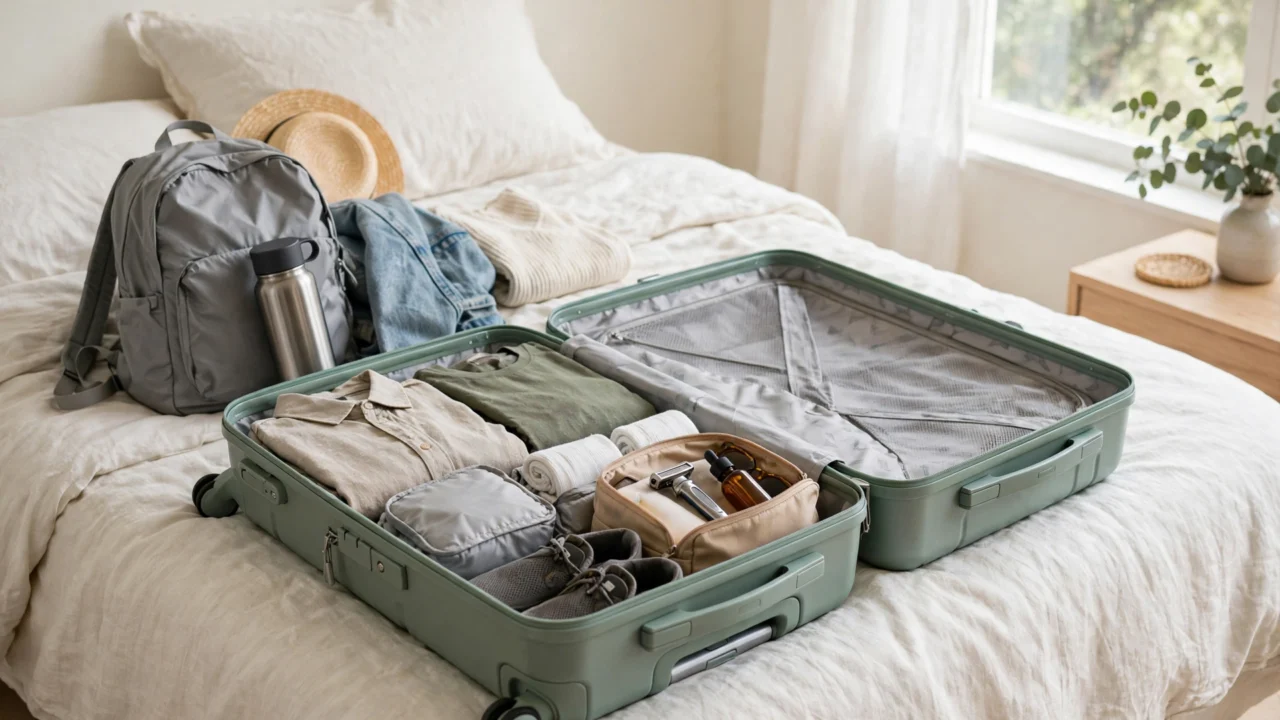
Short answer: The lightest luggage is the bag that is light when it is empty, strong enough for the way you travel, and just big enough for what you actually need. A light bag alone does not make a trip light. The real difference comes from choosing a simple, well-made case and packing only what you will really use.
Many travellers buy a bag because it looks light, then fill it with just-in-case items, heavy shoes and full-size toiletries. The bag still feels heavy, it is hard to lift into an overhead locker, and it is awkward to wheel through a busy station. This guide looks at the whole picture: the bag, the way you pack it, and the habits that keep it light.
What Makes Luggage Light?
When people talk about the lightest luggage, they usually mean the weight of the empty bag. That matters, because every part of the shell, frame, wheels and handles is weight you carry before you pack a single shirt. A bag with a simple frame, slim handles and two wheels will often weigh less than a similar bag with a heavy frame, four large wheels, extra pockets and a thick lining. The difference may seem small in a shop, but it becomes clear when you lift the packed bag or carry it up steps.
Materials also play a part. Light luggage is usually made from a thin but tough outer material, with a simple internal structure. Hard cases use a moulded shell, while soft cases use fabric stretched over a frame. In both cases, the lightest designs tend to have fewer extras, because each extra pocket, strap, lock and lining layer adds weight. A clean, simple design is often lighter and easier to use. Size matters too: a larger bag is heavier when empty, and it invites you to pack more. A smaller bag forces a useful question: do I really need this?
Hard Cases vs Soft Cases: Which Is Lighter in Practice?
Hard and soft cases both have loyal fans, and neither type is always lighter. A hard case has a rigid shell that protects what is inside from knocks, rain and pressure from other bags. That shell can be thin and light, but a thick shell, a heavy frame and large wheels can make it heavier than a simple soft case of the same size. A soft case has no rigid shell, so it can be lighter and can flex a little when you need to fit it into a tight space. It usually has outside pockets too, which are handy for documents or a light jacket.
The trade-off is protection. A hard case is a better choice if you pack fragile items, if your bag will be stacked with other bags, or if you want a surface that is easy to wipe clean after a wet journey. A soft case is often better if you want outside pockets, if you need to squeeze a bag into a small space, or if you prefer a bag that can expand a little for the return journey. Wheels matter as well. Two-wheel cases are often simpler and lighter, while four-wheel cases, often called spinners, stand upright and roll in any direction, which is easier in airports and hotels. Compare bags of the same size, lift them, and check how much usable space is inside.
Sizes and Weight Limits in General Terms
Airlines, trains and coaches all have their own rules, and those rules change. That is why it helps to think in general terms rather than memorising one limit. Most trips use one of three sizes: a small cabin bag, a medium checked bag, or a large checked bag. A cabin bag is meant to fit in an overhead locker or under a seat, so it is the smallest and easiest to manage. A medium bag suits a trip of several days, while a large bag suits a longer stay.
Before you travel, check the size and weight rules for your own ticket and carrier. The rules for a cabin bag are often stricter than the rules for a checked bag, and a bag that is fine on one journey may be too large or too heavy on another. Measure your bag when it is packed, including the wheels and handles, because those parts count towards the overall size. Weigh it at home if you can, so there are no surprises at the airport, and leave a little room and weight in hand in case you buy anything on the way home.
How to Pack Light Without Leaving Things Behind
Packing light is not about leaving out things you need. It is about choosing well, so that everything you pack earns its place. Start with a list, and write it before you open the case. Think about the weather, the activities you have planned, and how many days you will be away. Then choose clothes that work together, so that one top goes with more than one bottom and one pair of shoes suits more than one occasion. Choose versatile clothes in colours that mix easily, and roll clothes rather than folding them in thick stacks, which can save space and reduce creasing in some fabrics.
Keep heavy items near the wheels, where the weight is easier to manage, and keep the things you need during the journey in a small bag that stays with you. For more ideas on packing in a way that is easy to manage, see our guide to travel tips for senior citizens on packing light, which explains how a lighter bag and a clear packing plan can make a whole trip more comfortable. Take small toiletries, too, and remember that many hotels and shops sell the basics at your destination. If an item is only there in case something unlikely happens, leave it out unless it is essential. Finally, do a test pack a day or two before you travel. If the bag feels heavy, take something out.
What to Avoid When Choosing the Lightest Luggage
Avoid choosing a bag by weight alone. A very light bag that is poorly made, has weak wheels or a handle that bends under load will not stay light in practice, because it will be hard to move and may need to be replaced sooner. Look at the quality of the zips, stitching, wheels and handle. Avoid bags with too many features you will not use, and avoid buying a bag much larger than you need, since a large bag invites overpacking. Avoid packing at the last minute, when it is easy to throw in extra items without thinking. Finally, avoid assuming that a light bag means you can ignore weight limits. Even the lightest luggage can become heavy when it is full, so check the rules for your journey and weigh your bag before you leave.
Frequently Asked Questions
What is the lightest luggage for a short trip?
For a short trip, a small cabin bag is usually the lightest and simplest choice. It forces you to pack only what you need, it is easy to lift and wheel, and it avoids waiting for a checked bag.
Is a hard case or a soft case lighter?
It depends on the design rather than the type alone. A simple soft case is often lighter than a heavy hard case, but a thin hard case can be lighter than a soft case with a heavy frame and many pockets. Compare bags of the same size and lift them when they are packed.
How can I make my luggage lighter without buying a new bag?
Pack fewer clothes and choose items that work together. Take small toiletries, leave just-in-case items at home, and use a small day bag for the things you need during the journey. A test pack a day before you travel will show you what you can leave out.
Should I choose the smallest bag I can find?
Not always. The smallest bag is not the best choice if it forces you to leave out things you really need or if it is so full that it is hard to close. Choose the smallest bag that comfortably fits your usual trip, with a little room to spare.




1 Comment