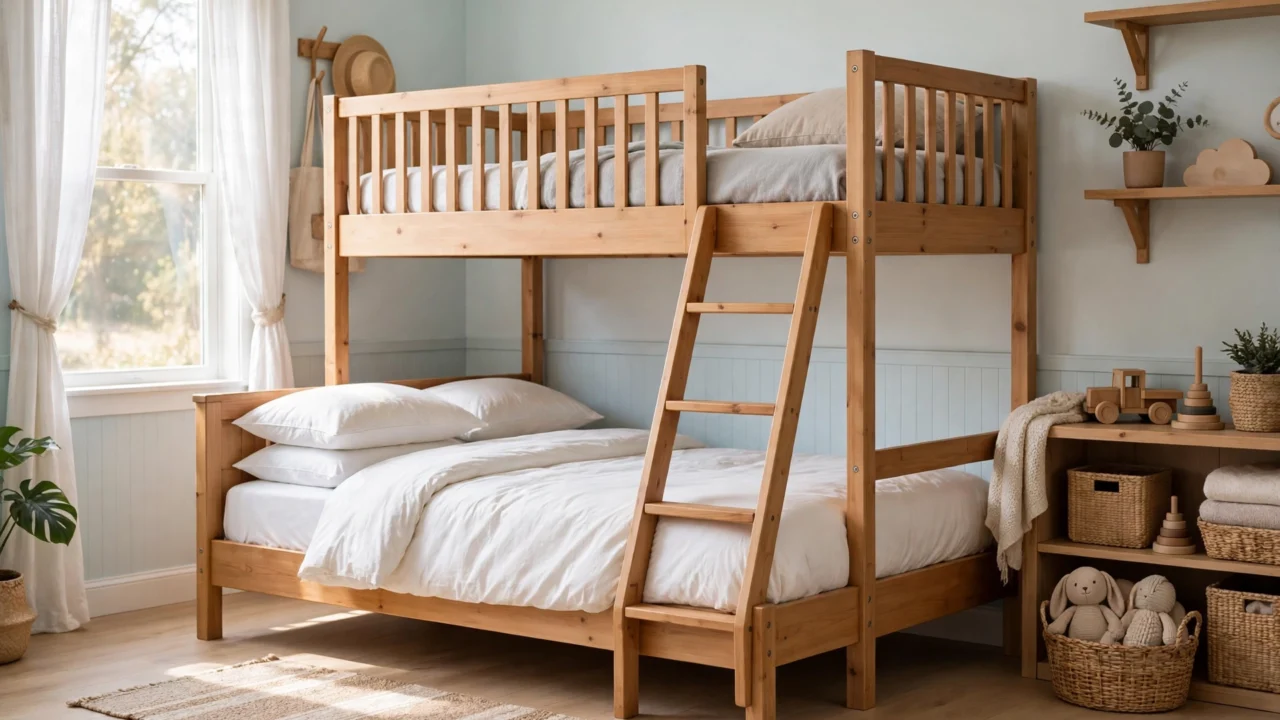
A twin full bunk bed stacks a twin mattress on top and a full mattress underneath, so two people sleep in the floor space of one bed — but the bottom sleeper gets 16 extra inches of width. It is the layout to look at when a twin over twin feels too narrow for the lower bunk, yet a full over full would swallow the room. Before you buy one, three numbers decide whether it works: the frame size against your room, the guardrail height against the top mattress, and the weight rating against who will actually sleep on it. Get those three right and the rest is style.
## What a Twin Full Bunk Bed Actually Is
A twin full bunk bed — also sold as a twin over full bunk bed — is exactly what the name says. The upper bunk takes a standard twin mattress, 38 inches wide by 75 inches long. The lower bunk takes a standard full mattress, 54 inches wide by 75 inches long. Both mattresses are the same length, so the bed is no longer than a twin over twin; it is only wider at the bottom.
That extra width is the whole point of the design. A twin is fine for a child, but it gets tight for a teenager, a restless sleeper, or a parent who lies down next to a small child at bedtime. The full bottom bunk gives that person room to stretch out, while the twin top bunk keeps the frame narrower than a full over full. Most frames stand 63 to 72 inches tall, and many split apart into two separate beds — a twin and a full — when the children outgrow sharing a room. If that matters to you, check the product description for “converts to two beds” before ordering, because not every model does it.
## Twin Full Bunk Bed Dimensions: Will It Fit Your Room?
A typical assembled twin over full frame measures about 78 to 80 inches long, 56 to 58 inches wide, and 63 to 72 inches tall. The frame is always a few inches bigger than the mattresses it holds, because the posts, rails and end panels add 2 to 5 inches on each side. Measure the frame, not the mattress, and then add walking space: leave at least 24 inches of clear floor on the ladder side so the top sleeper can climb in and out without shuffling sideways, and keep the long side of the bed a few inches off the wall unless the model is designed to sit flush against it.
Ceiling height matters more than floor space. Safety guides consistently call for at least 30 inches of open space between the top mattress surface and the ceiling, with 33 to 36 inches preferred so the top sleeper can sit up without hitting their head. In a room with a standard 8-foot ceiling, that usually works out fine — a 65-inch frame plus a 6-inch mattress puts the top sleeper’s head around 71 inches off the floor, leaving about 25 inches to the ceiling, which is tight but workable; a low-profile frame or a thinner mattress buys back a few inches. In a room with a sloped ceiling, measure at the spot where the bed will actually stand, not at the highest point of the room. Between the bunks, allow about 36 inches from the top of the lower mattress to the underside of the upper bunk frame, so the person below can sit upright to read.
| Measurement | Typical figure |
|—|—|
| Top mattress | Twin, 38 × 75 in |
| Bottom mattress | Full, 54 × 75 in |
| Assembled frame | 78–80 in long × 56–58 in wide × 63–72 in tall |
| Top mattress to ceiling | At least 30 in; 33–36 in preferred |
| Lower mattress to upper bunk frame | About 36 in |
| Clear floor on the ladder side | At least 24 in |
## The Safety Rules Worth Checking First
Bunk beds in the United States are covered by federal safety rules, and the numbers in them are specific enough to check against any product listing. Children’s bunk beds fall under 16 CFR Part 1513, other bunk beds under 16 CFR Part 1213, and the voluntary consumer safety specification is ASTM F1427. You do not need to memorise the regulations — four checks cover almost everything that goes wrong.
First, the guardrail. The top edge of the guardrails on the upper bunk must sit at least 5 inches above the top surface of the mattress. That is the rule that decides your mattress thickness: a thick mattress eats the guardrail margin, so most top-bunk mattresses are capped at 6 to 8 inches thick, and many manufacturers specify a maximum of 6 inches. If you already own a 10- or 11-inch mattress, do not put it on the top bunk. Measure the rail height above the platform on the listing, subtract the mattress thickness, and confirm at least 5 inches remain.
Second, the gaps. Openings in the upper bunk structure must be no wider than 3.5 inches, the width that blocks the entrapment test probes used in the standard. Check the space between the guardrail and the mattress, and between the guardrail and the frame — a mattress that is too short or too narrow for the frame leaves a gap a child can slip into.
Third, the age rule. The American Academy of Pediatrics and the ASTM standard both say children under 6 should not sleep on the upper bunk. It is not about size; a small child can be strong enough to climb the ladder and still lack the judgment to stay behind the guardrail at night. The lower bunk is the right place for a child under 6.
Fourth, the ladder. A ladder set at 70 to 75 degrees is easier to climb than a steep vertical one, which matters for younger children and for anyone climbing up in the dark. Check which side the ladder is on and whether it can be moved, because a ladder that lands against a wall or a wardrobe is a ladder nobody will use properly. And never hang hooks, belts, ropes or jump ropes from any part of the bunk — the strangulation warning printed on every bunk bed label exists because children have been hurt that way.
## Weight Limits: Check the Model, Not the Category
There is no standard weight limit for a twin full bunk bed. The number depends on the frame material and construction, so the spec sheet for the exact model you are buying is the only figure that counts. As a rough guide, metal tube frames typically support 200 to 250 pounds per bunk, while solid hardwood frames usually support 300 to 400 pounds per level. Some manufacturers rate the full bottom bunk higher than the twin top — one common twin over full model rates its bottom bunk at 450 pounds — because the wider lower frame can carry more.
Read the rating the way the manufacturer wrote it. Some list a static weight limit, others a per-sleeper limit, and a few rate the top and bottom bunks separately. If an adult will sleep on the bottom bunk regularly, look for a frame rated at 400 pounds or more on that level, and treat any listing that does not publish a weight limit at all as a reason to pick a different bed. Weight ratings are also the reason to tighten every bolt when you assemble the bed and re-check them after the first month — a bunk that wobbles is usually a bunk with a loose joint, not a weak frame.
## Twin Full vs Twin Over Twin vs Full Over Full
The three common layouts differ in width, not length, so the choice is really about who sleeps where.
| Layout | Top mattress | Bottom mattress | Typical frame | Best for |
|—|—|—|—|—|
| Twin over twin | Twin 38 × 75 in | Twin 38 × 75 in | 78–80 × 41–43 × 61–65 in | Two young children, smallest rooms |
| Twin over full | Twin 38 × 75 in | Full 54 × 75 in | 78–80 × 56–58 × 63–72 in | Siblings of different ages, guest rooms |
| Full over full | Full 54 × 75 in | Full 54 × 75 in | 78–82 × 58–61 × 65–75 in | Two teens or adults, larger rooms |
A twin over twin is the narrowest and cheapest, and the right call when both sleepers are small children and floor space is tight. A twin over full costs a little more and needs about 15 extra inches of width, but it buys a bottom bunk an adult can actually sleep on. A full over full needs the most floor space and suits two teenagers or adults sharing a room. If you are choosing between twin over twin and twin over full for two children, ask who will use the bottom bunk in three years’ time — a 12-year-old on a twin bottom bunk is a different proposition from a 7-year-old on one.
## Who a Twin Full Bunk Bed Suits Best
The layout earns its keep in four situations. The first is siblings of different ages: the older child gets the wider bottom bunk, the younger one takes the top once they are old enough for it, and nobody has to give up their own bed when friends stay over. The second is a guest room that doubles as a child’s room — the full bottom bunk sleeps an adult guest comfortably, which a twin bottom bunk does not. The third is bedtime itself: a parent can lie on the full bottom bunk to read to a child on the top bunk without perching on the edge of a twin. The fourth is a teenager sharing with a younger sibling, where the teenager needs the width and the younger child is happy up top.
It suits those situations less well when the room is very small. A twin over full frame is about 15 inches wider than a twin over twin, and in a room under 10 feet wide that width can be the difference between a usable desk and no desk at all. It is also the wrong choice if the ceiling is low — under 8 feet, measure the top-mattress-to-ceiling gap carefully, and consider a low-profile frame. And if both sleepers are adults, a full over full or two separate beds will serve better than a twin top bunk nobody over 5 feet 6 inches will enjoy.
## Five Checks Before You Buy
Run through this list with the tape measure and the product page open, in this order.
1. **Measure the room, then the frame.** Confirm the assembled length and width, add 24 inches on the ladder side, and check the bed fits without blocking a door, a window or a wardrobe.
2. **Measure the ceiling gap.** Frame height plus mattress thickness, subtracted from the ceiling height at the bed’s exact spot, should leave at least 30 inches — 33 to 36 is better.
3. **Check the guardrail maths.** Guardrail height above the platform minus the top mattress thickness must leave at least 5 inches of rail showing.
4. **Read the weight rating for the exact model.** Make sure the bottom bunk rating covers the heaviest person who will sleep on it, and that the top bunk rating covers its sleeper too.
5. **Confirm the extras you are counting on.** Does it split into two beds? Which side is the ladder on, and can it move? Does it include a trundle or storage drawers, or are those sold separately? Is the mattress included, or is that a separate purchase?
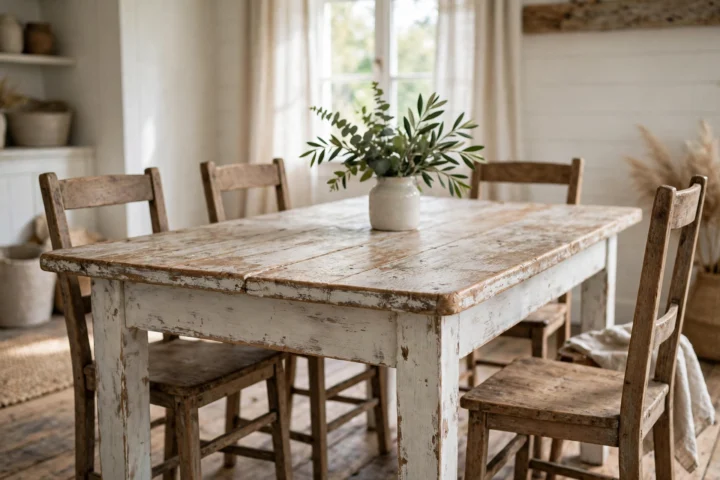
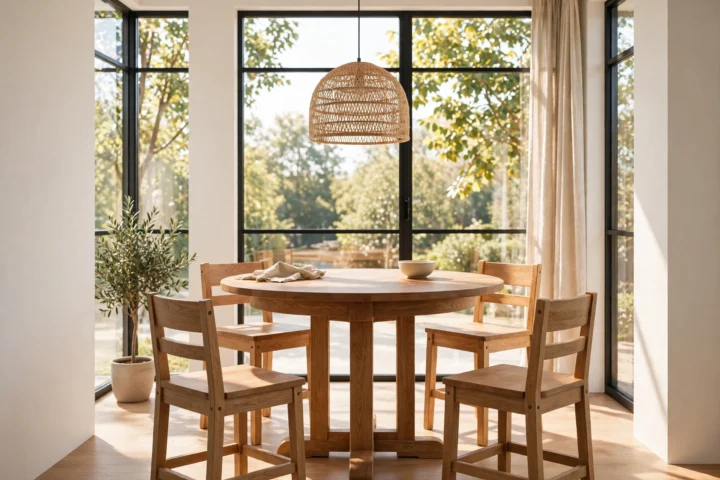
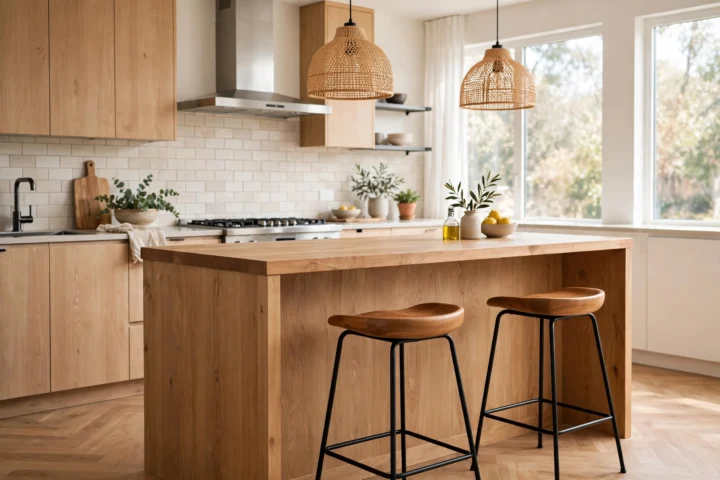
Furniture in a shared room has to work as a set, not as single pieces. If you are matching wood finishes across the room, a distressed dining table (https://mypublicpost.com/distressed-dining-table/) in a similar tone can tie a bedroom and a dining area together when the two rooms sit side by side, and the same finish-first thinking applies when you choose a farmhouse dining table and chairs (https://mypublicpost.com/farmhouse-dining-table-and-chairs/) to sit near a timber bunk. Smaller pieces follow the same rule — saddle bar stools (https://mypublicpost.com/saddle-bar-stools/) in a matching wood finish keep a shared living space feeling deliberate rather than assembled from leftovers.
## Frequently Asked Questions
**What size mattress does a twin full bunk bed take?**
A twin mattress, 38 by 75 inches, on the top bunk and a full mattress, 54 by 75 inches, on the bottom bunk. Both are the same length; only the width differs.
**How thick can the top bunk mattress be?**
Usually 6 to 8 inches at most, because the guardrail must stay at least 5 inches above the mattress surface. Many manufacturers specify a 6-inch maximum for the top bunk — always follow the label on your exact bed.
**What age can sleep on the top bunk?**
Six years and older. Children under 6 should use the lower bunk only, following the guidance of the American Academy of Pediatrics and ASTM F1427.
**Can adults sleep on a twin full bunk bed?**
On the bottom bunk, yes, if the frame is rated for it — look for a bottom-bunk rating of 400 pounds or more. The twin top bunk suits children and smaller teens better than adults.
**Do twin full bunk beds come apart into two beds?**
Many do, splitting into a separate twin bed and a separate full bed, but not all. Check the product description for “separates into two beds” before you buy if that matters to you.
A twin full bunk bed is a compromise, and compromises work when you choose them on purpose. Measure the room, check the guardrail against the mattress, read the weight rating for the model in front of you, and the bed that arrives will be the bed you actually wanted — one narrow bunk up top, one properly wide bunk below, and a room that still has space to move in.
2 Comments