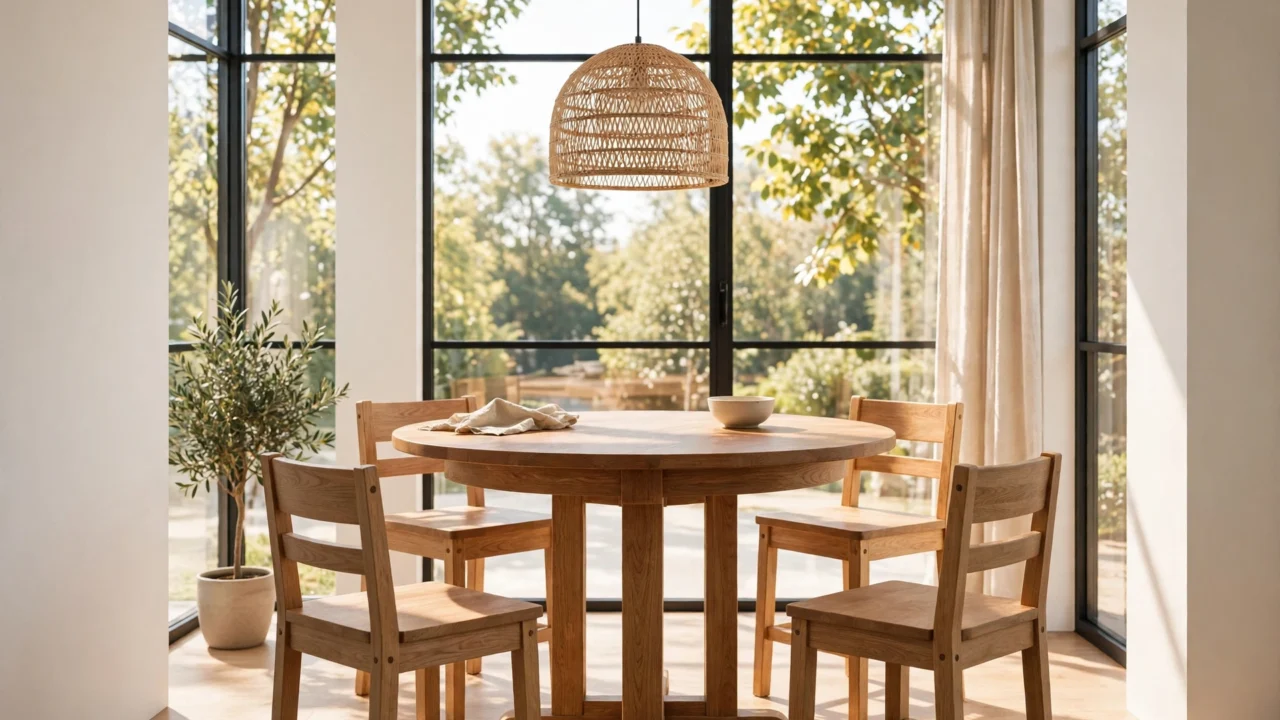
A 5 piece counter height dining set is one table and four stools, built a little taller than a standard dining set. The table usually stands 34 to 36 inches high, and the stools sit 24 to 26 inches off the floor. That extra height changes how a room feels: the set reads more like a kitchen island with seating than a formal dining table, and it fits neatly into spaces where a full dining table would crowd the room.
It is a good fit for small dining areas, open-plan kitchens, apartments and breakfast nooks. It is less suited to households where very young children, older relatives with limited mobility, or anyone who struggles to climb onto a taller seat will use it every day. If everyone at the table is comfortable perching a little higher, the format works well; if not, a standard-height set is the safer buy.
This guide walks through the five decisions that matter — size, configuration, material, seating and style — so you can buy once and keep the set for years.
What “5 Piece” and “Counter Height” Actually Mean
“Five piece” is simply a count: one table plus four stools. Some sets swap one stool for a bench, but the classic version is four individual seats. “Counter height” refers to the table height, which matches a kitchen counter at roughly 36 inches, compared with a standard dining table at 28 to 30 inches.
That height difference has practical consequences. Counter height stools need a footrest, because your feet will not reach the floor. Look for a footrest ring or stretcher bar built into the stool, not added as an afterthought — a stool without one gets uncomfortable within minutes. The seat height should leave about 10 to 12 inches between the seat and the underside of the table, which is why 24-inch stools pair with 36-inch tables.
Measure the people who will use it, not just the room. A stool seat around 17 to 18 inches wide suits most adults; narrower seats feel cramped for long meals. If anyone in the household is tall, check the stool’s weight capacity and seat depth rather than guessing — a deeper seat, around 16 to 17 inches, is noticeably more comfortable for longer sits.
Measure First: The 5 Numbers That Decide Fit
Before looking at a single product page, take these five measurements. They decide whether a set works in your room, and no amount of good design fixes a set that does not fit.
- Table footprint. A typical 5 piece counter height dining set table is 36 to 48 inches across. Round tables in this range seat four without sharp corners; rectangular tables of similar length seat four with a little more elbow room.
- Clearance around the table. Leave at least 36 inches between the table edge and the nearest wall or furniture, so stools can be pulled out and people can walk past. In a tight room, 30 inches is the workable minimum.
- Stool pull-out space. Each stool needs roughly 24 inches of depth behind it when pulled out. Push-in space matters too: stools that tuck fully under the table save floor space when the set is not in use.
- Doorways and stairs. Measure the narrowest doorway or stair turn on the delivery route. Many counter height tables ship with legs detached, but a solid tabletop can still be awkward to manoeuvre.
- Ceiling and light height. A pendant light over a taller table hangs lower relative to seated heads. Allow at least 30 inches between the tabletop and the bottom of the light fitting.
Write the numbers down and compare them with the product dimensions on every listing. Listings that omit dimensions are a warning sign — a seller confident in the fit publishes them.
The 4 Configurations Worth Comparing
Not all five-piece sets are built the same way. These are the four layouts you will see most often, and the trade-off in each.
| Configuration | Best for | Watch out for |
|---|---|---|
| Round table, 4 stools | Small rooms, easy conversation, no sharp corners | Less usable surface for serving dishes |
| Square table, 4 stools | Corners and nooks, tidy against a wall | Corners can feel tight for larger diners |
| Rectangular table, 4 stools | Longer rooms, spreading out dishes | Needs more floor space than round |
| Table with 2 stools + bench | Families with children, flexible seating | Bench seating is less comfortable for long meals |
Round tables are the most forgiving in a small space, because there are no corners to bump into and everyone faces the centre. Square sets suit a room with a defined corner or a kitchen nook. Rectangular sets work when the room is long rather than square. The bench version is practical if children will use the set, since a bench holds two small diners easily — but adults tend to prefer individual stools with backs for anything longer than a quick breakfast.
Whichever layout you choose, check whether the stools tuck under the table. A set that stores compactly looks tidier and frees the room between meals, which matters in the small spaces these sets are made for.
Materials That Hold Up — and Ones That Don’t
The material decides how the set ages. Here is what to expect from the common options.
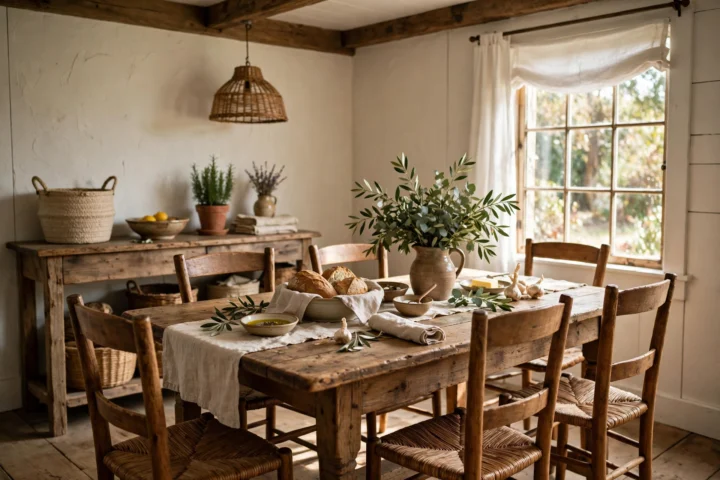
Solid wood is the most durable choice and the easiest to repair — a scratched top can be sanded and refinished. Hardwoods such as oak, rubberwood and acacia handle daily use well; soft pine dents more easily. Wood suits a warm, traditional look, and it pairs naturally with the kind of dining room where a farmhouse dining table and chairs already feel at home.
Wood veneer over engineered wood costs less and looks similar at first, but it chips at the edges and cannot be refinished. It is a reasonable choice for a lightly used set, but not for a table that will host every meal.
Metal frames with wood or upholstered seats are sturdy and suit a modern or industrial look. Check that the joints are welded or bolted rather than glued, and that the feet have protectors so they do not scratch hard floors.
Glass tops look light and open up a small room, but they show every fingerprint and crumb, and a chipped edge is hard to fix. Tempered glass is the only safe option — avoid any listing that does not say the glass is tempered.
Stone or marble-look tops are heavy and expensive, and they stain unless sealed regularly. They look impressive but need more care than most households want for an everyday table.
For most buyers, a solid wood top on a wood or metal base is the best balance of durability, repairability and price. Whatever you choose, ask how the surface should be cleaned — a top that needs special products for every spill will not stay looking good for long.
Before you buy, also check how the set arrives. Most counter height sets ship flat-packed with the legs and footrests detached, so assembly is part of the purchase — look for clear instructions, labelled parts and all fixings included in the box. A set that needs two people and an hour to assemble is normal; one that wobbles after assembly is not. Once built, test the table on your actual floor: a slight wobble on tile or uneven boards is usually fixed with adjustable feet, but a table that rocks because the legs are uneven will annoy you every day. Tighten every bolt after the first week of use, since new joints settle and loosen slightly.
Seats Matter More Than the Table
People remember the stools long after they forget the table. A good stool has a footrest, a seat wide enough to sit on comfortably, and a weight capacity that covers everyone who will use it. Backless stools tuck neatly under the table and suit a clean, minimal look, but they offer no support for long meals. Stools with a low back give support without blocking the view across the room, and full-back stools are the most comfortable — at the cost of taking up more visual space.
Swivel stools are convenient in a kitchen setting, where people turn to face different directions, but the swivel mechanism is the first part to wear out on a cheap set. If you choose swivel, look for a metal mechanism with a warranty rather than a plastic one. Upholstered seats in fabric or faux leather are more comfortable than bare wood, but fabric stains — choose a wipeable surface if children will eat at the table, and check whether the seat covers can be removed for cleaning.
If you already own stools, compare carefully before buying a full set: saddle bar stools are a common pairing with counter height tables, and getting the seat height right matters more than matching the finish exactly. A 24-inch seat on a 36-inch table is the standard pairing; a 26-inch seat will leave your knees pressed against the tabletop.
Style: Matching Without Looking Matchy-Matchy
A five-piece set does not need to match your kitchen exactly — it needs to belong in the room. Start with the largest surface, the tabletop, and match its tone to the room’s dominant wood or finish rather than to every small detail. A warm wood top works with both light and dark cabinetry, while a black metal frame ties in with black fixtures and handles.
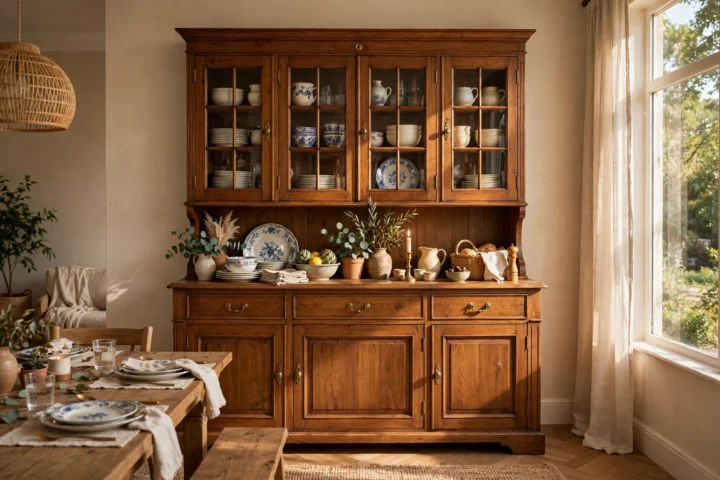
If your dining area already has storage furniture, think about the set as part of that picture. A hutch and buffet in a similar wood tone anchors the room and gives the taller table a visual partner at standard height, which keeps the counter height set from looking like it wandered in from the kitchen. The goal is a room that feels collected, not a showroom set bought in one click.
Colour is the easiest place to go wrong. Neutral tops — natural wood, white, grey, black — stay flexible if you redecorate. Bold coloured sets look striking in photos but limit your choices later, and a coloured laminate top shows wear sooner than a neutral one.
7 Mistakes Buyers Make
- Buying the wrong seat height. A 30-inch bar stool with a 36-inch table leaves no legroom. Match 24-inch stools to a 36-inch table.
- Skipping the tape measure. Guessing the footprint is how a set ends up blocking a walkway. Measure the room and the delivery route.
- Choosing backless stools for long dinners. They look tidy, but nobody enjoys a two-hour meal without back support.
- Ignoring weight capacity. Check the rated capacity of each stool, not just the table — cheap stools often rate far lower than they look.
- Falling for a glass top in a busy household. Fingerprints, crumbs and chips are a daily reality with children or frequent cooking.
- Forgetting the floor. Metal legs without protectors scratch hardwood and tile. Budget for felt pads if the set does not include them.
- Buying on looks alone. Sit on the stool, or at least check seat depth, width and footrest position, before committing.
Frequently Asked Questions
What size room do I need for a 5 piece counter height dining set?
A 10 by 10 foot space works for most sets, with at least 36 inches of clearance around the table. Smaller rooms can work with a round table and stools that tuck fully underneath.
Are counter height dining sets comfortable for everyday meals?
Yes, for most adults, as long as the stools have a footrest and a back or low back for support. They are less comfortable for very young children and anyone with limited mobility, who may find climbing onto a taller seat difficult.
Can I buy the table and stools separately?
Often, yes — and it is worth considering if you already own stools at the right height. Buying separately lets you choose a better stool, but check the seat-to-table gap stays at 10 to 12 inches.
A Quick Decision Checklist
Before you order, run through this list: the table footprint fits with 36 inches of clearance; the stools are 24 inches high for a 36-inch table; every stool has a footrest; the seat is at least 17 inches wide; the material suits how often the table will be used; the stools tuck under the table; and the delivery route fits the tabletop. If all seven check out, the set will serve your room well — and if two or more fail, keep looking. The right 5 piece counter height dining set is the one that fits your room, your household and your daily routine, not the one that looks best in a product photo.
2 Comments