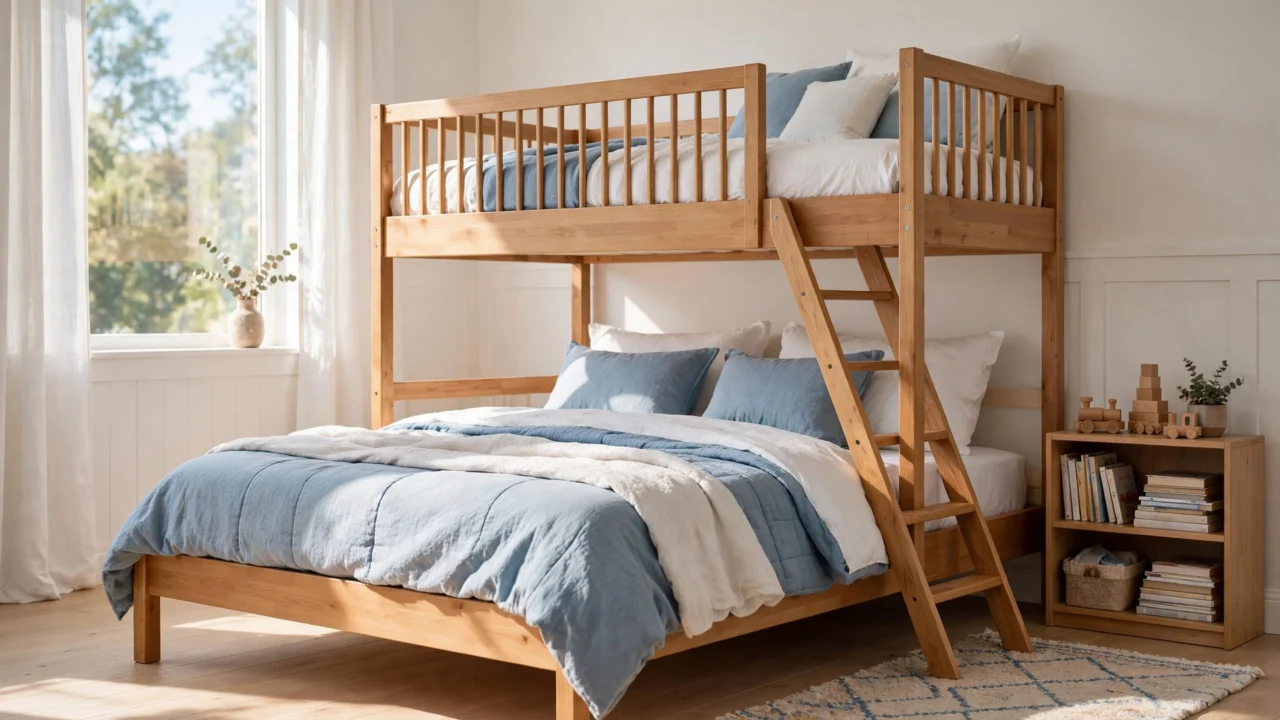
What Is a Twin Bunk Over Full Bed?
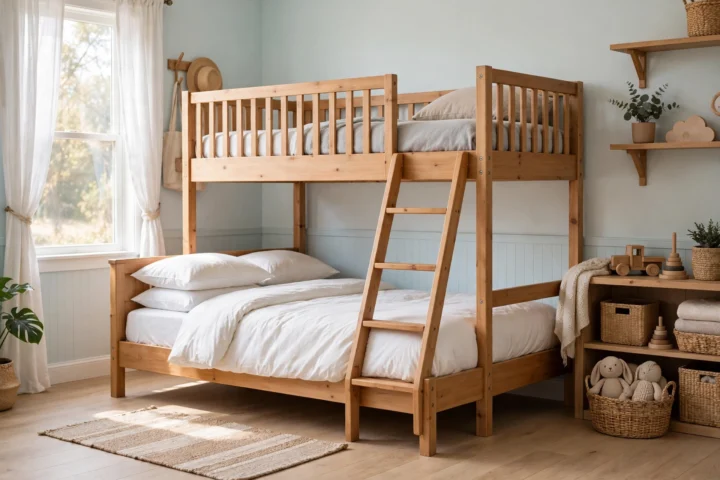
A twin bunk over full bed has a single (twin) bed on top and a double (full) bed underneath. The top mattress is 38 by 75 inches, the standard twin size; the bottom is 54 by 75 inches, the standard full size. The frame is roughly 78 to 80 inches long, 56 to 59 inches wide and 61 to 72 inches tall.
That one change is the whole point of the design. A twin-over-twin sleeps two children; a twin bunk over full bed sleeps three — one on top, and two children or one adult below — in the footprint of a single bed. That is why it is so common in shared kids’ rooms, holiday homes and guest rooms that double as a child’s bedroom.
If you are still weighing the basic configuration, our guide to choosing a twin full bunk bed covers dimensions and safety rules in detail. This guide answers the narrower question: who is a twin-over-full actually for, and how do you know it will work in your room?
5 Situations Where a Twin Over Full Bunk Bed Makes Sense
1. Three children sharing one bedroom
This is the classic case. Two children can share the bottom full bed while the third takes the top bunk, leaving floor free for a desk or wardrobe. It works best while the two sharing the bottom are young: a full mattress is 54 inches wide, so each child gets 27 inches. Teenagers sharing a full bed will feel cramped.
2. Sleepovers without an air mattress
For a family whose children regularly host friends, the full bottom bunk is a built-in sleepover bed. One guest sleeps on the bottom with your child, or two guests share it, and nobody ends up on an air mattress on the floor. If sleepovers happen monthly, that alone can justify the wider frame.
3. A guest room that is also a child’s room
When grandparents or other adults visit, they sleep on the full bottom bunk at normal bed height — far more comfortable than climbing to a top bunk. The rest of the time the room belongs to the child on top. A twin-over-twin cannot do this: an adult on a 38-inch-wide top bunk is neither comfortable nor, in many models, within the weight limit.
4. An older child and a younger sibling
Give the older child the top bunk and the younger sibling the bottom — unless the younger one is under six, in which case no child under six sleeps on top. The full bottom also gives a parent room to sit beside a younger child for bedtime stories, which a twin bottom does not.
5. A small rental or holiday home
In a holiday let or a small second bedroom, sleeping three people in the footprint of one bed is a genuine gain: guests get real beds instead of a sofa bed. Check the weight rating first, because adult guests are heavier than the children most bunk beds are designed around.
Twin Over Full vs Twin Over Twin vs Full Over Full
The three common configurations look similar in a photo but suit different households. Here is how they compare on the points that decide a purchase.
| Configuration | Sleeps | Footprint (approx.) | Best for | Watch out for |
|---|---|---|---|---|
| Twin over twin | 2 | 42 x 80 in | Two children of similar age | No room for an adult or a third sleeper |
| Twin over full | 3 | 58 x 80 in | Three children, sleepovers, adult guests | Needs a wider room; bottom can feel crowded for two teens |
| Full over full | 4 | 58 x 80 in | Four sleepers, older children and teens | Tallest and heaviest; needs the most ceiling height |
The twin-over-full is the middle option in every sense: one more sleeper than a twin-over-twin, without the height and weight of a full-over-full. For exactly three sleepers, or two sleepers plus regular guests, it is usually the right size. For four children, skip straight to the full-over-full.
Will It Fit Your Room?
Measure before you order. The frame is about 58 inches wide and 80 inches long, so allow 24 inches clear on the ladder side and 12 inches elsewhere. In a 10 by 10 foot bedroom that leaves room for a wardrobe and a small desk; in a room narrower than 9 feet wide, the bed will dominate the space.
Ceiling height matters more than floor space. Measure from the top of the top mattress to the ceiling: you need at least 30 inches so the child on top can sit up, and 33 to 36 inches is more comfortable. With a 65-inch frame and a 6-inch top mattress, that means a ceiling of at least 8 feet in practice. With a ceiling fan, check the blades clear the top bunk — and never position the bed so the top sleeper can reach the fan.
Around 36 inches between the bottom mattress and the underside of the top bunk lets the person below sit up to read. Less than that, and the bottom bunk feels like a cave.
Safety Checklist Before You Buy
Bunk beds are safe when built and used properly, and the rules are specific enough to check against a product listing before you spend anything.
- Guardrails on both sides of the top bunk, with the top of the guardrail at least 5 inches above the top mattress — the US Consumer Product Safety Commission standard, and the single most important number on the listing.
- Top mattress no thicker than 6 to 8 inches. A thick mattress raises the sleeper above the guardrail and defeats it. Check the manufacturer’s maximum — never guess.
- Gaps no wider than 3.5 inches anywhere a child’s head or torso could pass — between guardrail and mattress, and around the ladder opening.
- No children under six on the top bunk — the CPSC and American Academy of Pediatrics guidance, even if the younger child is a confident climber.
- A weight limit that fits your sleepers. Ratings vary by model — metal frames commonly rate the top bunk around 200 to 250 pounds, solid hardwood around 300 to 400 pounds. Always use the manufacturer’s rating for the exact model, not a generic figure.
- A fixed ladder or angled stairs, firmly attached. Stairs are easier for younger children and double as storage, but take more floor space. Whichever you choose, it should not wobble.
- Assembly checked twice: tighten every bolt, then re-tighten after the first month of use. Most bunk-bed failures trace back to loose fasteners, not to the frame.
Mattresses: What Goes Where
The top bunk takes a twin mattress, 38 by 75 inches, no more than 6 to 8 inches thick, and no box spring — a box spring would lift the sleeper above the guardrail. Slats or a low-profile bunk board support it instead. The bottom bunk takes a full mattress, 54 by 75 inches, where a standard 10- to 12-inch thickness is fine because the guardrail rule does not apply there.
Buy the firmness each sleeper prefers, but never swap them later: a thick bottom mattress moved to the top bunk is a safety problem, not a comfort upgrade.
Mistakes to Avoid
Buying before measuring the ceiling. Floor space is the measurement everyone takes; ceiling clearance is the one that causes returns. Measure from the top of the intended top mattress.
Ignoring the weight rating. A bed rated for children will not safely hold two adults on the bottom bunk, however solid it looks. If adults will sleep on it regularly, buy a model rated for adult weight.
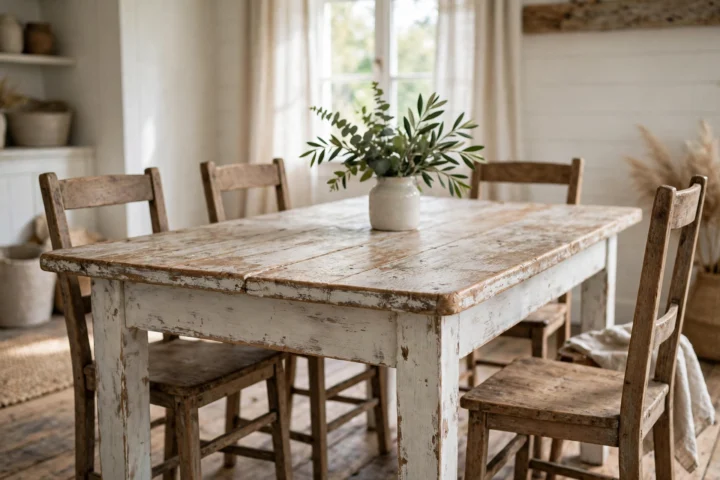
Choosing on looks alone. A solid-wood frame costs more than a metal one, but it is quieter and usually carries a higher weight rating. The same buy-once logic applies to the room’s other furniture — our guides to choosing a distressed dining table and a saddle bar stool set make the same point about solid wood outlasting cheaper materials.
Forgetting bedding clearance. Thick duvets and pillows raise the sleeper closer to the ceiling and the guardrail top. Measure clearance with the bedding on, not with a bare mattress.
Frequently Asked Questions
Can adults sleep on a twin bunk over full bed?
Yes, on the bottom full bunk, provided the model’s weight rating covers them. An adult should not sleep on the top twin bunk — it is 38 inches wide and rated for a child’s weight.
What size mattress does a twin bunk over full bed use?
A twin mattress (38 by 75 inches) on top, no thicker than 6 to 8 inches, and a full mattress (54 by 75 inches) on the bottom — no box spring on the top bunk.
How much ceiling height do you need?
At least 30 inches from the top of the top mattress to the ceiling, 33 to 36 inches for comfort. In practice that usually means an 8-foot ceiling or higher.
Is a twin over full better than a twin over twin?
For three sleepers, regular guests or sleepovers, yes — it sleeps one more person in nearly the same floor space. For exactly two children of similar age, a twin-over-twin is cheaper and takes up less room.
A twin bunk over full bed earns its place when you have three sleepers, frequent guests, or a room that must work as both a child’s bedroom and a guest room. Measure the ceiling, check the guardrail height and weight rating, and buy the size that fits your household — not the one that looks best in the photo.
2 Comments